August 21, 2026 · Michael Anthony
Nobody is booking you because your photos got better
Most photographers keep reinvesting in craft long after craft stopped being the thing holding them back. Here is the math on two photographers with identical work and a $44,000 gap, and where that money actually came from.
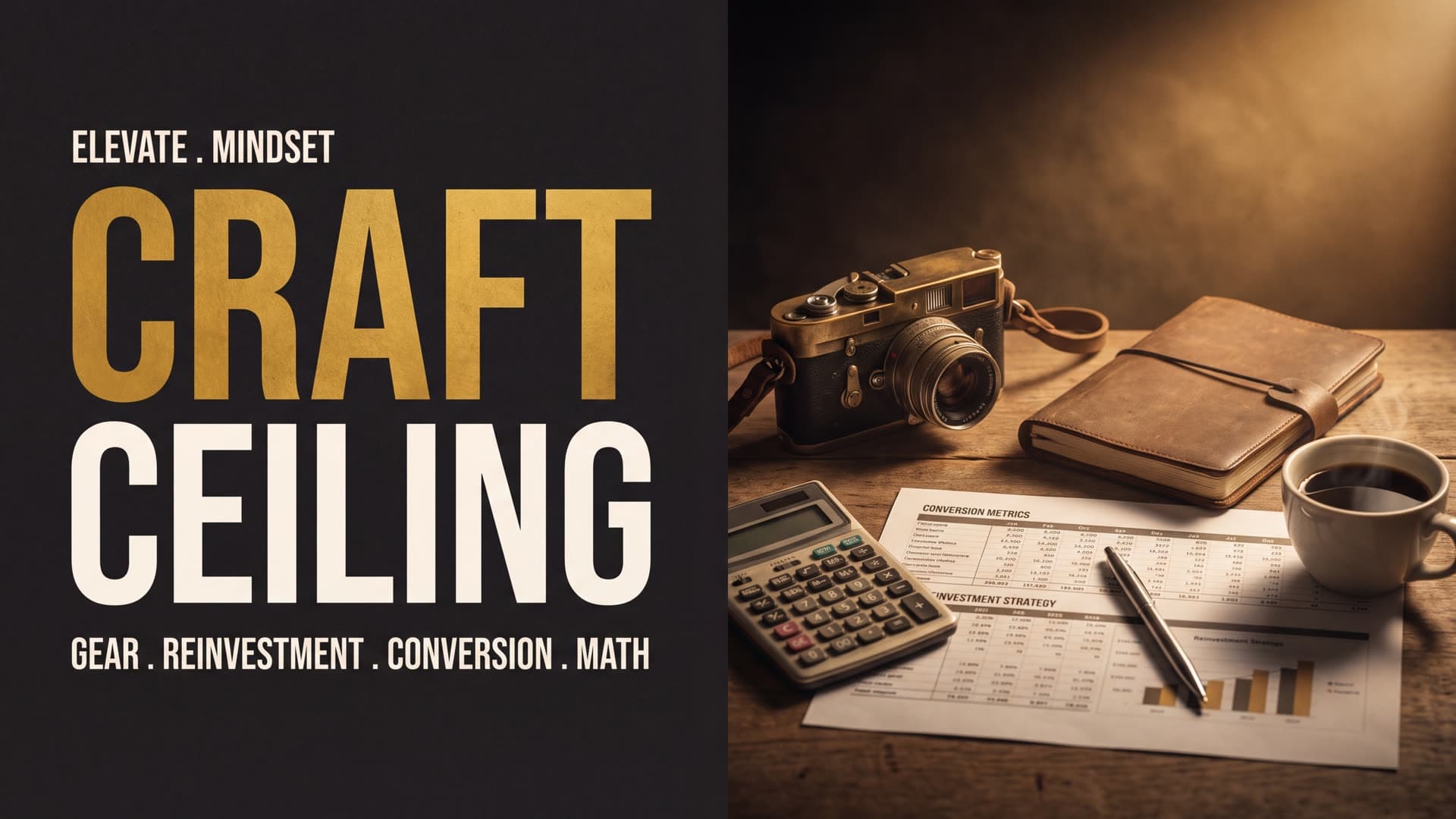
A photographer told me last month that he was saving for a $6,400 lens because his work needed to be sharper before he could raise his prices. He has been shooting nine years. His work is already good. He books eleven weddings a year at $3,100 and he has quietly decided that the distance between where he is and where he wants to be is an optical problem.
It is not. He crossed the line where craft mattered to his income somewhere around year three, and he has been paying tuition on the wrong subject ever since.
Craft has a ceiling as a business input
This is the part nobody says out loud at a workshop. Skill behind the camera is a threshold, not a slope. You have to clear a bar to be hireable at a real price. Once you clear it, more skill stops producing more revenue, because the person paying you cannot see the difference.
Your peers can see it. Judges at print competition can see it. The client cannot. Ask a couple why they booked you and nobody has ever said the word falloff. They say you got back to them fast. They say the meeting made sense. They say you were the only one who showed them what they would actually end up with on the wall.
Every one of those is a business function. None of them is a photography function. And every one of them is cheaper to fix than a lens.
The math
Two photographers in the same market. Both shoot work an honest observer would call an 8 out of 10.
Photographer A spends the year on craft. A $6,400 lens, an $1,800 workshop, a $299 editing course, and roughly 120 hours on personal projects and re-editing old galleries. Call it $8,500 and 120 hours. His work ends the year at maybe an 8.5. He books eleven weddings at $3,100. That is $34,100.
Photographer B leaves the gear alone. She puts $6,000 into Meta ads and gets leads at about $45, so roughly 133 of them. She books 12 percent, which is 16 weddings. She also spends $2,200 on sales training and rebuilds her consultation so it presents three options instead of one price, which moves her average from $3,100 to $4,900. Sixteen bookings at $4,900 is $78,400.
Same photographs. Slightly less money spent. A gap of $44,300 in twelve months.
Photographer A did not do anything lazy. He worked hard on the thing that felt like the job. He just aimed 100 percent of his reinvestment at a variable that had already stopped moving.
What actually moved the number in my studios
I run two studios, DFW and Southern California, and I still shoot weddings alongside the portrait work. So I get to watch this play out with real money instead of theory.
The single biggest revenue change we made last year had nothing to do with images. We cut median lead response time from a little over four hours to under nine minutes. Same ads, same budget, same price sheet, same photographs. Booking rate on those leads went from roughly 9 percent to 17 percent. That is close to double the business off a change that lives entirely in a workflow.
The second biggest was the ordering appointment. We started designing one wall piece for the client's actual room before they arrived instead of handing over a gallery link. Portrait average went from about $1,400 to $2,900 across both locations. Not one dollar of that came from getting better at photography.
To be clear, this is not permission to let the work slide. You have to hold the bar you have. Craft is something you maintain. It is just not something that compounds after a point, and your reinvestment should follow the thing that compounds.
What to do this week
- Run the ratio. Add up everything you spent in the last 12 months on gear, workshops, presets, and editing tools. Then add up what you spent on ads, sales training, a CRM, and hired help. Most photographers find they are running 90/10 toward craft. Write both numbers down where you can see them.
- Fix response time. Set an auto-reply that goes out in under 60 seconds and a personal reply inside 10 minutes during business hours. This costs nothing and it is usually worth more than any lens you will buy this year.
- Rebuild one consultation. Three options, anchored high, presented in that order. Not a price list emailed as a PDF.
- Put a product in front of them. Design one wall piece at the size it will actually hang, and show it before you talk about money.
- Cap craft spend at 20 percent of reinvestment for the next twelve months. Everything else goes to demand and conversion. Revisit in a year with real numbers, not a feeling.
If you want to work through the response and consultation piece with other photographers who are running the same experiment, the Inner Circle is free and that is most of what gets discussed in there. Join it here. Bring your ratio from step one. It is usually the fastest conversation you will have all month.