May 29, 2026 · Michael Anthony
The asset test
Most working photographers spend their week on work that disappears the moment they stop. The studios that scale spend it building things that keep working while they sleep. Here is how to tell the difference.
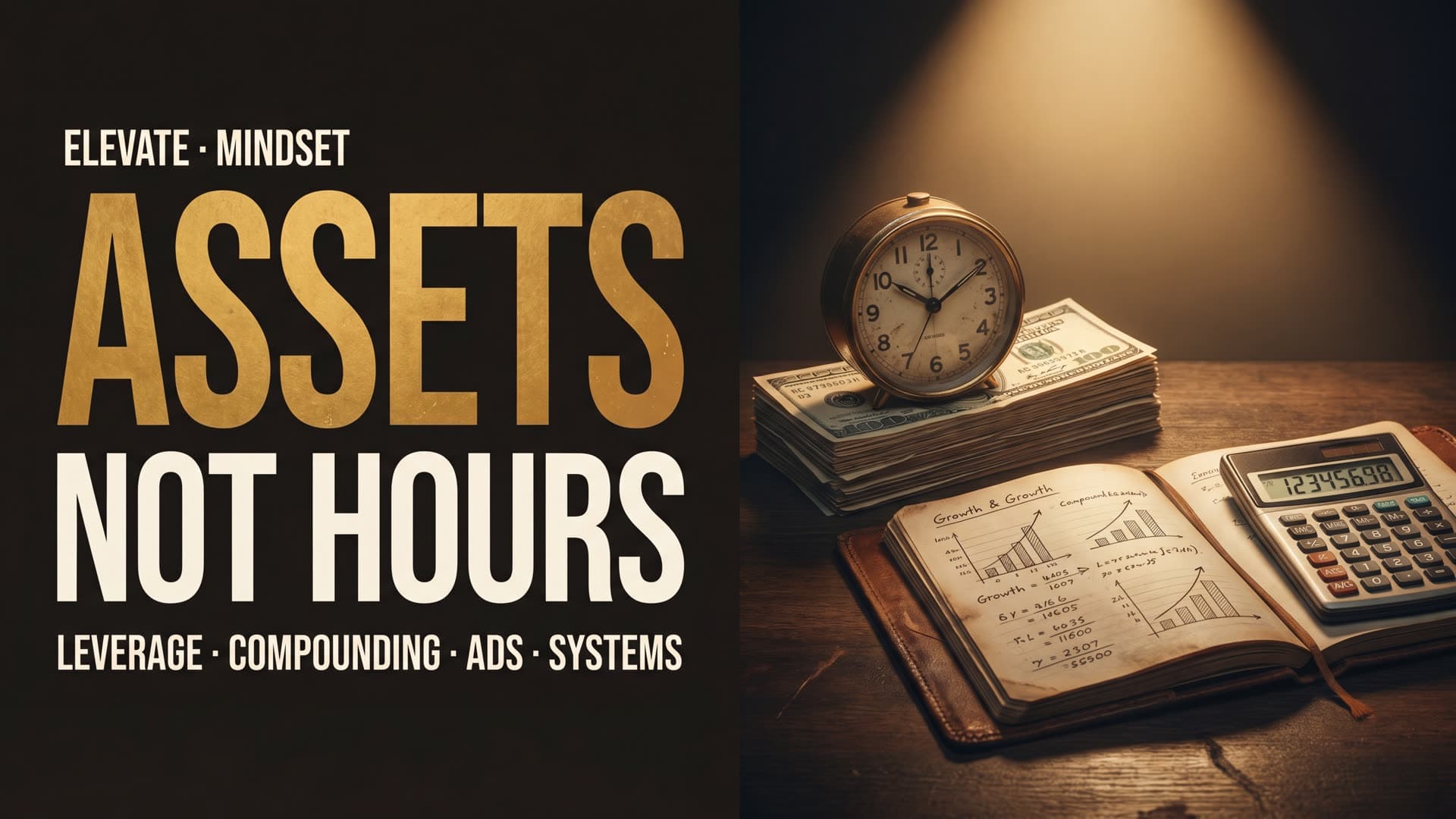
Open your calendar from last week and look at where the hours actually went. Editing. Posting. Replying to DMs. Filming a reel. Rebuilding the pricing PDF for the third time. Now ask one question about each block: if I stop doing this today, does it keep paying me, or does it stop the second I stop?
That is the asset test. Almost everything a stuck photographer does fails it.
The reframe
There are two kinds of work. Hours, and assets.
Hours are work you trade once. You shoot a wedding, you get paid for that wedding. You post a reel, it gets seen for 48 hours and then it is gone. You answer a lead at 9pm, that lead is handled and the next one starts from zero. Hours do not compound. The day you stop, the income stops.
Assets are work you do once that keeps paying. A pricing structure that books the right client every time without you renegotiating. A sales process that closes at 55 percent whether you are in the room or your associate is. A paid ad that runs for 60 days untouched and brings in leads while you are shooting in another state. An email sequence that follows up with every inquiry on autopilot. You build it once. It works on a Tuesday when you are asleep.
Most photographers spend 90 percent of their week on hours and wonder why they cannot get off the treadmill. You cannot out-hustle a structural problem. There are only so many hours, and yours are already full.
The math
Take the most common time sink in this industry: organic content.
Say you spend 50 hours a month on it. Filming, editing, captioning, posting, engaging. That is a real number for photographers chasing the algorithm. At a conservative $75 an hour for your time, that is $3,750 of your labor a month, $45,000 a year, poured into a channel you do not own and cannot predict. A good month might bring 3 or 4 inquiries. A bad month brings zero, and the platform never tells you why.
Now take that same effort and put it into an asset.
At my DFW studio we built a single portrait offer with a paid ad behind it. The ad took about 8 hours to write, shoot, and set up. Budget was $2,000 for the month. That one ad, running mostly untouched, brought in 19 booked consultations. Close them at a 55 percent rate on a $3,200 average and that is roughly $33,000 from 8 hours of build time and $2k of spend. The organic grind cost more in time and produced a fraction of the bookings.
Here is the part that matters. The next month, the ad was already built. The pricing was already set. The sales process already existed. The marginal cost of the second month was the ad spend and almost none of my time. That is what compounding looks like. The organic photographer started the next month back at hour zero.
Same business. Same skill. The difference was which kind of work the month was spent on.
The tactical takeaway
You do not need to stop everything tomorrow. You need to shift the ratio. Try this week.
- Run the asset test on your calendar. Take last week, block by block, and label each one "hour" or "asset." Most people find 80 to 90 percent of their week is hours. Seeing it on paper is the wake-up call.
- Pick one asset and build it this month. Not five. One. The highest-leverage first asset for most working photographers is a real follow-up sequence, because you already have the leads and you are losing them to silence. Second is a single paid ad behind one clear offer.
- Cap the hours that fail the test. If organic content is eating 50 hours a month, cut it to 10 and protect the other 40 for asset-building. The sky does not fall. I run two studios across DFW and California, and the calendar does not live or die on whether I posted a reel on Thursday.
- Measure the asset after 60 days, not 6 days. Assets are slow to start and then they compound. An ad needs data. A sequence needs reps. Judge it on the quarter, not the afternoon.
The photographers who break past $200k did not find more hours. Nobody has more hours. They moved their existing hours out of work that disappears and into work that stacks.
If you want the build order we use (which asset to build first, second, and third, with the ad framework and the follow-up sequences), the course library lays it out step by step. If you want to watch other working photographers build these in real time and compare notes, the Inner Circle is free and full of people doing exactly this.
Mike