June 4, 2026 · Michael Anthony
Build a wedding collection menu that holds its price
A step-by-step system for structuring three wedding collections that protect your average sale, kill the race to the cheapest package, and build album revenue in on purpose.
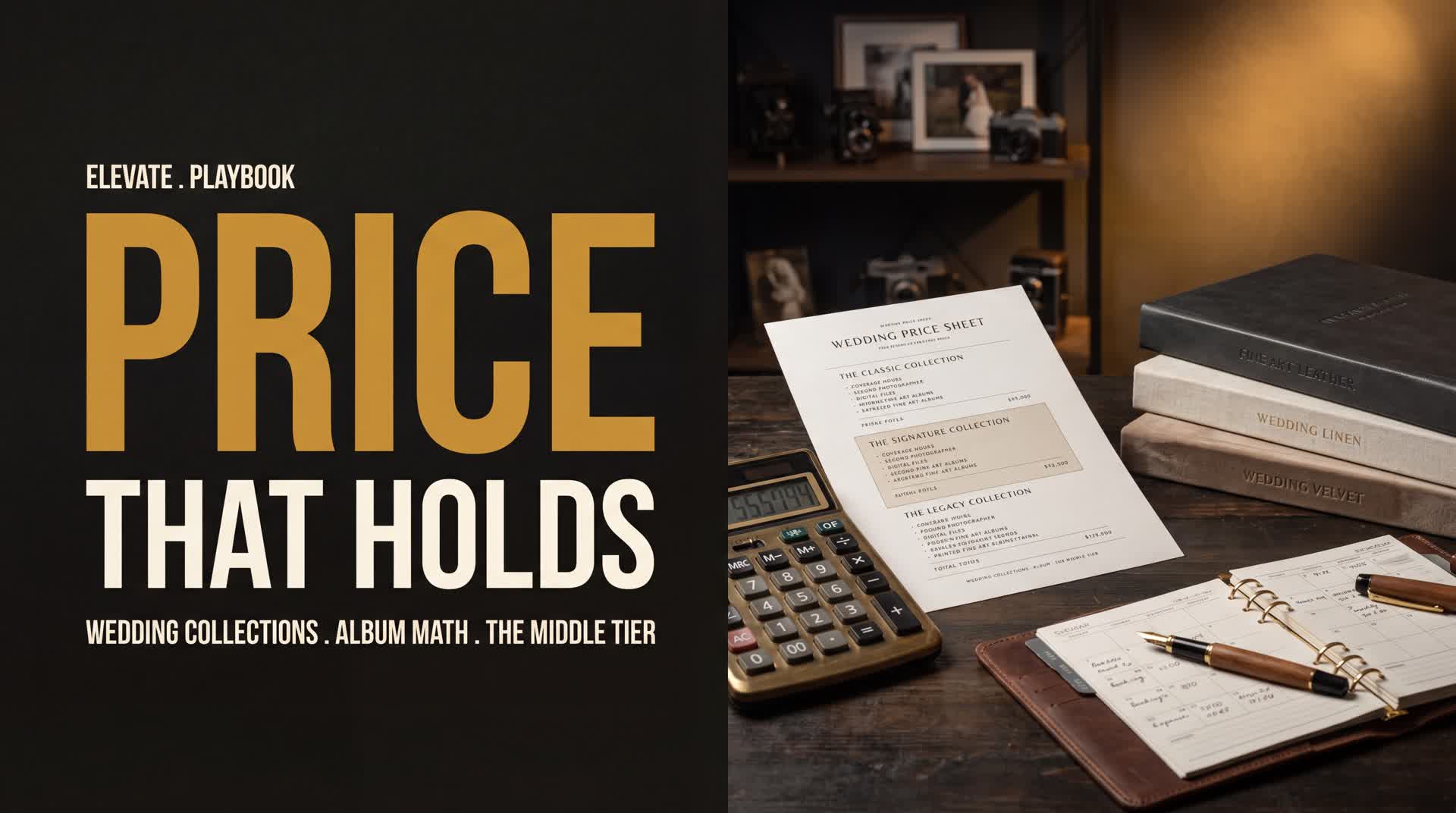
Here is the pattern I see in almost every wedding studio stuck under $100k. The pricing PDF has three or four packages, the couple picks the cheapest one almost every time, and the average booking lands a few hundred dollars above the floor. Then the studio tries to fix it by raising the floor, the inquiries dry up, and the panic discounting starts. The problem is not your number. The problem is that your menu was never built to move couples up. It was built to be read top to bottom and chosen from the bottom.
A collection menu that holds its price is engineered, not guessed. Here is the exact system I use, and the math behind it.
Start from the average you need, not the package you want
Most photographers build the cheapest package first and add to it. Build it backward instead. Start with the average booking you actually need to hit your revenue goal.
Say you want $130k in wedding revenue and you can comfortably shoot and deliver 20 weddings a year. That is a $6,500 target average. Every pricing decision after this serves that one number. Your job is not to sell the most expensive collection. Your job is to design a menu where the math pulls the average toward $6,500 without you negotiating.
The three-tier anchor structure
Three collections. Not four, not five. Five tiers create decision paralysis and couples retreat to the floor. Three tiers create a clear middle, and the middle is where you win.
- The floor. Priced below your target average. This exists to make the middle look obvious, not to be sold. If most couples book this, the menu is broken.
- The middle. Priced at or slightly above your target average. This is the collection you actually want 60 to 70 percent of couples to choose. Everything about the menu should point here.
- The anchor. Priced well above the middle. Few couples buy it. Its job is to make the middle feel reasonable by comparison and to catch the rare couple who wants everything.
The anchor is the most important line on the page even though almost nobody buys it. Without a high anchor, your middle becomes the ceiling, and ceilings get discounted.
A worked example
Here is a real menu built to a $6,500 target average:
Collection One, $4,500. 8 hours of coverage, edited gallery, print release. No album. No second shooter.
Collection Two, $6,900. 9 hours of coverage, edited gallery, print release, second shooter, and a 10-spread fine art album valued at $1,800 inside the collection.
Collection Three, $9,800. 10 hours, two shooters, the album upgraded to 15 spreads, an engagement session, and parent albums.
Look at what the structure does. The jump from One to Two is $2,400, and for that the couple gets a second shooter and an $1,800 album. The value gap makes Two the obvious choice. The album is not an add-on a couple has to opt into. It is built into the collection you want them to pick, so album delivery becomes the default outcome of a normal booking, not a separate sale you have to win later.
The album math nobody runs
A 10-spread fine art album from a pro lab costs you around $300 to $400 depending on cover and paper. Inside Collection Two you have valued it at $1,800. That is not the price you sell it for standalone. It is the value you attribute to it inside the bundle, and it costs you roughly $350 to fulfill.
Now the upsell. When a Collection One couple asks to add an album after the wedding, you sell the same 10-spread book at $1,800 a la carte. Your cost is still $350. That is a roughly $1,450 margin on a product you were going to design anyway. Run that across 20 weddings and album revenue alone can move your average by $800 to $1,200 without raising a single base price.
This is the lever most wedding studios leave on the table. The shooting is capped by how many weekends exist. Album and print revenue is not.
How to present it so the middle wins
The menu structure only works if the consultation points to it. Three rules:
- Lead with the middle, not the floor. When a couple asks about pricing, anchor the conversation on Collection Two first. "Most of our couples book our 9-hour collection because it includes the second shooter and the album." You have just told them what normal looks like.
- Name the floor's tradeoffs out loud. "Collection One works if you have a small, single-location day and you are not sure you want an album." You are not insulting it. You are letting them disqualify themselves from it.
- Never discount the package. Adjust the deliverables. If the budget is tight, remove an hour or the engagement session. The price moves because the product moved, not because you blinked. The couple who books at full price next month should never be subsidizing the one you caved on.
If you want the deeper version of this, including the consultation script that does the pointing, the IPS flow for couples, and the off-season portrait work that fills the calendar between weddings, that is the entire focus of our resources for the wedding photography business.
What this looks like in practice
A studio doing 20 weddings at a $5,800 average is at $116k. Same 20 weddings, same calendar, rebuilt into the three-tier menu above with the album baked into the middle collection, and the average climbs to $6,800 because the structure does the selling. That is $136k from the exact same number of Saturdays. No extra shooting. No bigger audience. Just a menu engineered to move couples up instead of a list they read from the bottom.
Rebuild your menu backward from your target average, put a real anchor above the middle, and build the album into the collection you actually want to sell. The price holds because the structure holds it, not because you fought for it in the inbox.
We teach the full pricing-and-booking build, menu design through the close, inside Booking Blueprint 2.0. If you want to pressure-test your collection menu with other working photographers first, bring it into the free Inner Circle community and post it. Real numbers, real feedback.